Action Items for GMs: Tracking What Sessions Leave Open
Summary
Most GMs end a session with notes about what happened and a vague sense of what needs to happen before the next one. That vague sense is where campaigns start to drift. Action items -- specific, owned, time-bound follow-up tasks -- are the mechanism that keeps promises made at the table from disappearing before next session. This is a field report on a five-part format that holds across long campaigns.
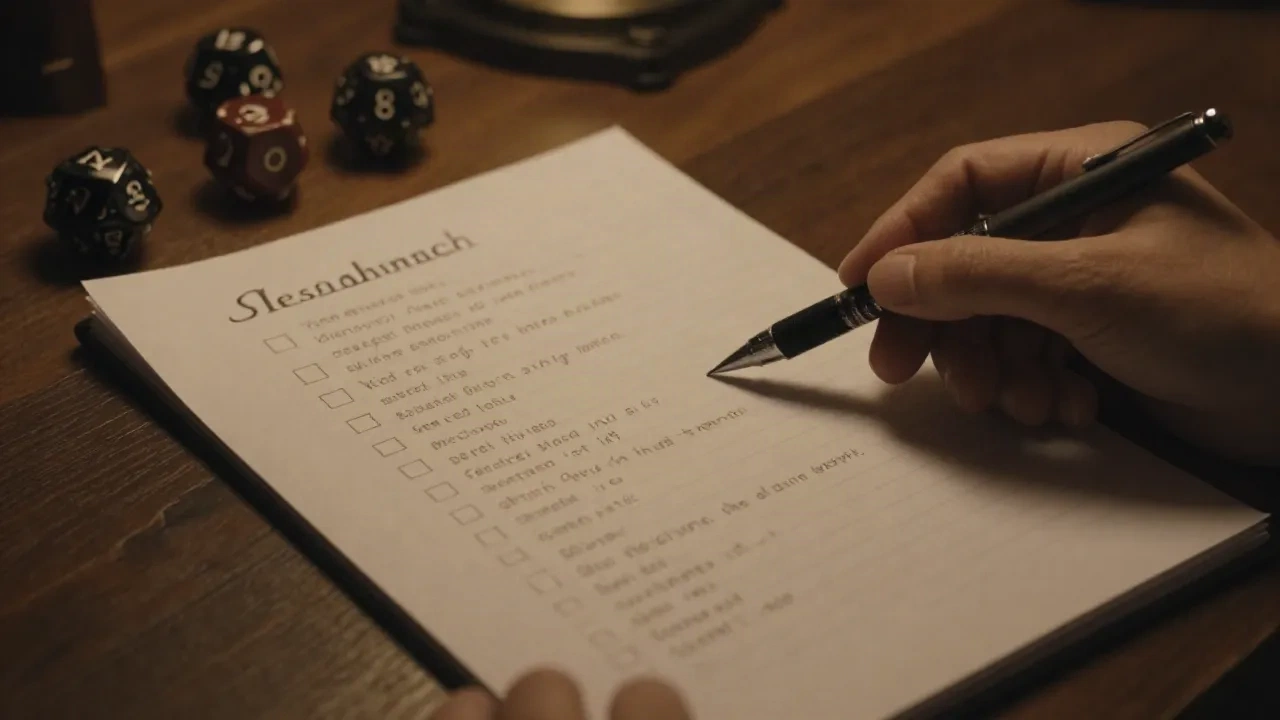
After 47 sessions of a Pathfinder 2e homebrew campaign, I learned what action items actually are -- the hard way. Session 47 ended with a ranger asking whether the ancient aqueduct under the city was still functional. I said "probably not" and moved on. Session 49, someone else asked about it and I said "yes, parts of it." By session 52, I'd promised three different things about the same aqueduct and the players had noticed the inconsistency.
That is the action item problem. Not the big lore gaps you plan around -- the small promises made mid-session that scatter across your notes and disappear before next week.
Action items, in a campaign context, are the specific follow-up tasks that sessions create: lore gaps to fill, NPC behaviors to define, faction states to update, threads to either pull or cut before the next table. They are short-lived by design (you resolve them before next session), but they carry enormous consequence if they go missing.
This is a field report on the system that has held up for me across 5 years and three long campaigns.
The Action Item Is Not the Same as the Session Note
Session notes are archival. They answer: what happened? An action item answers: what do I owe the campaign before we play again?
The distinction matters because most GMs take session notes and call it done. They end up with a detailed record of what occurred and almost no capture of what the session created -- the obligations, the gaps, the threads that need resolution before next Friday.
A session note: "Players discovered that Aldric Vane is working with the Merchant Consortium." An action item: "Define what Vane's actual motivation is -- the players will test him next session and I don't have an answer that holds."
The first is true and useful for reference. The second is a commitment to the campaign's integrity. The action item is what prevents me from improvising a contradictory answer under pressure.
What Deserves an Action Item (and What Doesn't)
Not every gap that surfaces mid-session needs a formal action item. The test is whether the gap will be probed again. If a player mentions something in passing and the table moves on, it probably doesn't need tracking. If a player acted on the thing, or if the fiction now depends on an answer existing -- that goes on the list.
Situations that reliably generate action items:
Unanswered questions that players treated as significant. When someone stops to write something down, or asks again after the session ends, they're signaling they'll follow up. The follow-up will happen whether or not you prepared for it.
NPC decisions made under improvisation. I improvise a lot. Most of it is fine. But when I improvise an NPC's response to a direct moral question, or their relationship to another faction, or whether they're lying -- I need to record what I said and make sure it becomes true in the Codex.
Player-created facts that I accepted. In collaborative TTRPG fiction, players sometimes assert things about the world and I say yes. "Does the dockworker know anyone in the Serpent Quarter?" "Yes, probably." That "probably" is now a fact. I need to know who.
Promised rewards or consequences. If I say "the duke will send a messenger within three days," that's a clock. If I don't track it, the messenger never comes.
What does not need an action item: background color you invented on the fly that was purely atmospheric ("the inn smells like pine resin"). Lore you'll never revisit. Improvised flavor that doesn't connect to anything the players are tracking.
The Five-Part Format That Actually Holds Up
The format I use is short enough to write mid-session on an index card and specific enough to be useful a week later.
What: One sentence, concrete. Not "Aldric Vane motivation" but "Write out Vane's actual reason for working with the Consortium -- it has to survive three direct questions from Mira's character."
Why it matters: One clause connecting it to something the players are tracking. This helps with triage when you have twelve action items and three hours of prep time.
Deadline: "Before session 53" or "resolve before the Merchant Quarter arc closes." This tells me how urgent it is.
Owner: In solo prep this is always me. In a co-GM situation, name the person.
Status: Open, In Progress, Closed. Nothing more complex.
The status column sounds obvious but it does one thing nothing else does: it lets me carry incomplete action items forward deliberately, with a reason, rather than forgetting them. An item that stays "In Progress" across three sessions is telling me something about my campaign -- either the answer is genuinely hard, or the players have moved on and I should close it.
How to Triage Action Items After the Session
I write action items during the session, in a separate column from my running notes. At the end of the session, before I close the notebook, I spend ten minutes doing three things.
First: tag every action item as High, Medium, or Low. High means the players will definitely probe this next session. Medium means it might come up. Low means it's background -- I should resolve it eventually but it won't block anything.
Second: close any items that resolved themselves during the session. Sometimes players create an action item in hour two and answer it themselves by hour four. Those close immediately.
Third: copy all High items onto a separate card that goes with my prep materials for next session. Medium and Low go into the Codex as open threads.
That's it. Fifteen minutes maximum. The session prep cycle then starts from that card, not from a vague memory of what felt unresolved.

When Action Items Outlive the Session They Came From
Some action items don't resolve in one prep cycle. A faction's political position might shift over multiple sessions. A character's backstory might stay "in progress" for a whole arc while you figure out how it connects to the main plot.
Long-lived action items are not a problem. Losing track of them is.
The solution is the Codex entry review. Once a month, I open the Codex and look at every thread marked "open." For each one, I ask: is this still relevant? Do the players care? Is there a session in the next three weeks where this lands?
Most long-lived items close during this review not because I wrote the answer but because I realized the question no longer mattered. The aqueduct is a good example: the players moved to a different district and never asked again. I closed that item six sessions after it opened.
The ones that survive the review are the load-bearing unresolved threads of the campaign. Those get elevated from action items to full Codex entries.
AI Tools That Help -- and the One Step They Can't Replace
The biggest practical improvement to my action item workflow in the last two years has been recording sessions and running them through an AI tool to extract a rough first pass at action items. The results are not clean -- the tool doesn't know the difference between an improvised detail and a load-bearing promise -- but they catch things I missed while I was focused on running the table.
The workflow: record the session audio (phone on the table, or through a virtual tabletop), run it through a tool that generates a transcript and extracts tasks or follow-ups, then review that list manually and prune it against the test above. What did the players treat as significant? What became a commitment?
The manual review step cannot be automated. The AI doesn't know your campaign. It doesn't know that "the gate was already open" is a throwaway line and "I've heard of this bloodline before" is a thread with eight sessions of consequence behind it. That judgment is yours. The tool saves you from transcription and catches the things you were too busy to write down -- which is already worth it.
Closing the Loop: The Recap Ritual That Keeps the Codex Honest
At the start of every session, I read back the High action items from the previous prep cycle -- not to the players, but to myself, ten minutes before we play.
This does two things. It confirms which items I resolved and which are still open. And it surfaces any item I thought I resolved but actually only partially addressed. (That happens more than I'd like. "Define what Vane's motivation is" has a way of becoming "I have a rough sense of it" when I'm short on prep time, which is not the same thing.)
The recap ritual is also the moment where I catch contradictions before the players do. If I said something in session 50 and something different in session 51 about the same fact, reading the action items side by side is where I find it. Canon is a promise. The recap ritual is how I check whether I kept it.
Running a Clean Campaign Is Not About Perfect Preparation
The GMs I respect most are not the ones with the most prepared sessions. They're the ones whose world holds up to scrutiny -- who can answer a direct question without contradicting themselves fourteen sessions later.
That consistency doesn't come from having everything planned in advance. It comes from tracking what each session creates: the promises, the gaps, the facts that are now in play.
Action items are the mechanism. The Codex is where they land when they're resolved. The recap ritual is how you check your own work. None of these tools are complicated. The difficulty is doing them every week, including the weeks when prep is short and you're tempted to skip the fifteen-minute review.
The aqueduct is still in my notes, closed, six sessions after it opened. I know exactly what it is now. My players never asked again -- but if they do, the answer is ready.