Objective Summary: The GM's Tool for Canon You Can Trust
Summary
An objective summary is a factual account of events, decisions, and outcomes stripped of opinion or interpretation. For GMs and fiction writers, it is the core tool for keeping campaign lore consistent across dozens of sessions. Write one after every session: who acted, what happened, what changed. Treat it as your canon record, not your emotional diary of the night. The lore either earns belief or it does not, and an objective summary is how you keep it honest.

Last Thursday my players walked into a scene I had mapped three sessions earlier. Faction leader Orryn Ashvale was supposed to be neutral, brokering peace between the Thornmere Guild and the River Compact. Except in my session notes from session 12, I had written: "Orryn seemed shifty, probably working with the Guild." That opinion had crept into my prep. By session 15, I had accidentally made him a villain without deciding to.
An objective summary would have caught that. It would have read: "Orryn met with representatives of both factions. No alliance was stated. Both factions departed without resolution." Clean, factual, no editorial drift.
That is the difference between notes that slowly corrupt your canon and notes that hold.
What an Objective Summary Actually Is
An objective summary records what happened, who acted, and what changed, without attaching meaning, suspicion, or emotional coloring to any of it. It is the same principle journalists use for wire reports: state the event, not the interpretation.
For GMs and fiction writers, the structure is simple:
Who was present and acted
What happened (decisions made, outcomes reached)
What changed in the world state (faction relationships, item locations, NPC status)
Nothing more. Not "the players seemed confused by the reveal," not "this NPC feels suspicious." Those belong in your personal prep notes, labelled clearly as interpretation. Your objective summary is the canon record.
This distinction matters because over 40 or 60 sessions, the only document you can trust is the one that does not carry your emotional state from a specific night.
Why GMs Get This Wrong (And Why It Costs Them Later)
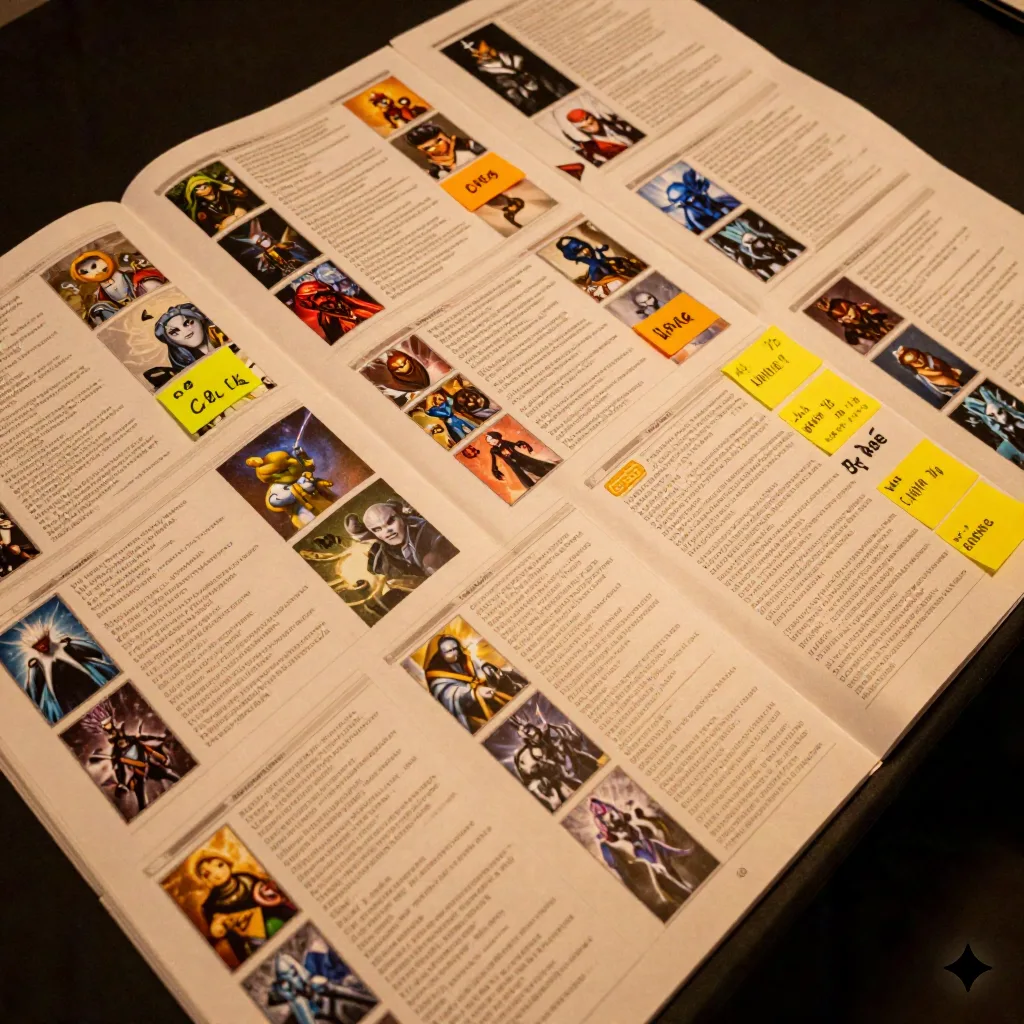
Most GMs write notes the way they talk to themselves after a session: "That was great, the players really bought the betrayal, I think Mira is becoming their favorite NPC." That is a journal entry. Useful for you, but not for your Codex.
The problem surfaces at session 22. You are prepping a scene involving Mira and you go back to your notes. Half of what you wrote is about how the players felt, not what Mira actually did. You fill in the gaps from memory, which by session 22 is reconstructed memory, shaped by everything that happened after. You have now invented canon without knowing it.
Three specific failure modes show up across long campaigns:
Drift through interpretation. You note that an NPC "looked nervous." That becomes "is untrustworthy" in your prep three sessions later. By session 30, the NPC has a secret agenda you never planned.
Crowded context. You write everything, including table chatter and player jokes. The actual facts of what happened in the fiction get buried. When you search your notes, you find five pages and cannot find the single line that matters: "The artifact was left in the vault."
Competing narratives. One player takes notes, you take notes, the recaps diverge. An objective summary, agreed on at the end of each session, becomes the authoritative version. Canon is a promise. Every inconsistency breaks it.
The Structure That Works After 14 Sessions
After running the same homebrew Pathfinder 2e campaign for 14 sessions without a consistent summary format, I switched to a fixed three-section template. The improvement in prep quality was immediate.
Section 1, Events (what happened) Bullet points only. One sentence each. Subject, verb, outcome.
The party entered Thornmere. Guildmaster Vael denied knowledge of the shipment. The party accepted the denial without pressing further.
Section 2, World state changes (what is now different) This is the section most GMs skip. It is the most important one.
Thornmere Guild: relationship with party = neutral (unchanged). River Compact: aware party visited rival faction. Artifact: still in vault per Vael's statement, unconfirmed.
Section 3, Open threads (what is unresolved) A short list of things that need a decision before next session. Not interpretation, not speculation. Just the unresolved facts.
Party has not decided whether to return the artifact or sell it. Vael's claim about the shipment is unverified. The locked room on the second floor was not searched.
Three sections, no prose, no adjectives. Fifteen minutes after each session.
How AI Assists Without Replacing the Work
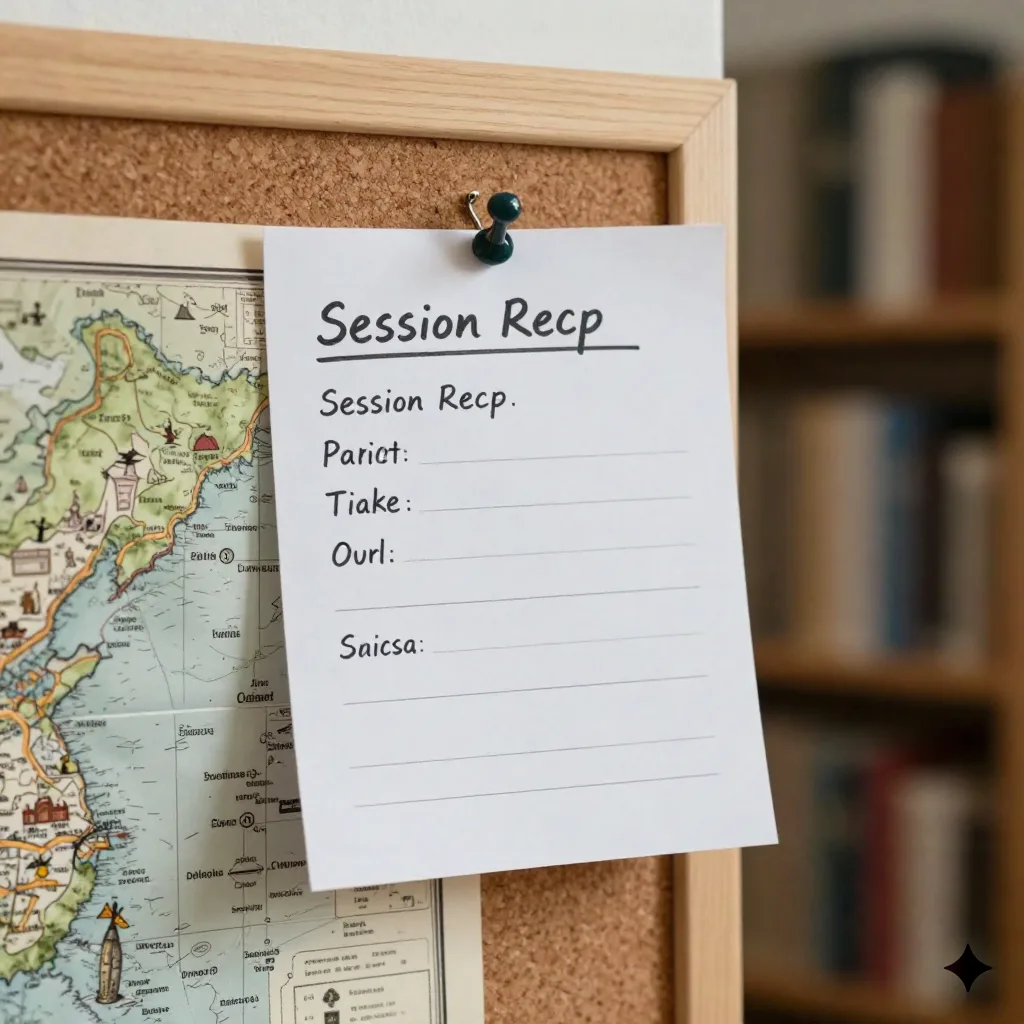
This is where tools like NotebookLM and the Koroverse Forge become genuinely useful, and where they can also mislead you if you are not careful.
What AI-assisted summarization does well: it can take a block of session notes, including the messy interpretive prose, and strip it down to factual statements. Ask it to produce only events and world state changes, and it will pull those out faster than you can. It is particularly good at catching things you glossed over, "the party mentioned the Compact three times and never followed up" shows up in an AI summary even if you forgot it by the time you sat down to write.
What it still requires from you: the decision about what counts as canonical. If your notes include both "Orryn seemed shifty" and "Orryn said he was neutral," the AI cannot decide which is true in your world. That judgment call is the GM's. The Forge produces the summary. You decide what the summary means for your canon.
A practical workflow that holds up at the table:
After each session, speak or type your raw recap into a document, unfiltered, as you experienced it
Run it through your AI tool with the prompt: "Extract only objective events, world state changes, and unresolved threads. Remove all interpretation and emotional language."
Read the output and flag any line that slipped through, any "seemed to" or "probably", and cut it manually
Add the cleaned summary to your Codex as the session record
Here is how it holds up at the table: after 30 sessions with this workflow, I have not had a single faction contradiction in my campaign. Before it, I was having one per arc.
Objective vs Subjective: The Line GMs Keep Crossing
The confusion between objective and subjective language is not a writing failure. It is a natural consequence of being emotionally invested in your world. You care about the story. That care leaks into your notes.
Objective statement: "The council voted three to two against granting the party access."
Subjective statement: "The council was clearly biased against the party."
Both can be true. Only the first belongs in your Codex. The second belongs in your prep notes under "GM interpretation, not canon."
A quick test for any line in your session record: could a neutral observer have written this based only on what happened in the fiction? If it requires knowing your intentions as a GM, or your read of a player's reaction, it is subjective. Pull it out.
The same test applies to fiction writers building a Codex for their manuscript. Your character's internal state is not an event. "Mira decided she no longer trusted the party" is an event only if it was shown, through action or stated dialogue, in a scene. If it was an authorial decision you made in the margins, it is not yet canon until it appears in the draft.
When the Summary Catches Contradictions Before They Break Your Campaign

The best argument for the objective summary is not efficiency. It is contradiction prevention.
Here is a real example from my campaign. Session 9: the party broke into a warehouse and found it empty. My note: "Warehouse: empty, possibly cleaned out ahead of their arrival." The word "possibly" is interpretive. I did not establish in the fiction why the warehouse was empty. I just assumed.
By session 18, I had built an entire arc around the warehouse being deliberately emptied by a spy. Except I had never actually set that up. I had taken my own "possibly" and treated it as fact.
An objective note would have read: "Warehouse: found empty. No evidence of contents or recent activity established in session."
That single word "established" would have reminded me that the reason was still unwritten, still open to decision. I could have chosen the spy angle, or the mundane explanation that the delivery was simply delayed, without having painted myself into a corner.
For writers: the same principle applies to continuity across chapters. When you write an objective chapter summary that records only what was shown on the page, you create a document you can check against later. When you write interpretive summaries, what you intended, what you hoped the reader would feel, you create a document that diverges from the actual manuscript and eventually contradicts it.
What the Tools Actually Generate vs What You Still Have to Write
A field note for anyone considering AI-assisted summarization for their Codex:
NotebookLM, given a full campaign session transcript, will produce a coherent summary. It handles names well, tracks locations, and does not editorialize much. What it misses: the distinction between things the party learned (information) and things the party confirmed (established fact). A player character might hear a rumor about the artifact. That rumor is not the same as confirmed canon.
Sudowrite and similar fiction-oriented tools are less useful for objective summaries because they tend toward narrative, they want to produce prose, which reintroduces voice and interpretation. Better for drafting scenes than for logging them.
The Koroverse Forge's strength for this specific task is that it can be given your structured three-section template and asked to populate it from raw notes, staying inside the format. That constraint is what makes it useful for Codex maintenance rather than just content generation.
Skip: tools that auto-generate session recaps for sharing with players. Those serve a different purpose, they are intentionally subjective and narrative, written to entertain. Your Codex record is not the same document as your player-facing recap.
Building the Habit Before Session 30
The GMs who struggle with lore consistency at session 40 are almost never the ones who ran bad sessions. They are the ones who never built a summary habit in the first place.
The window to fix this is smaller than it looks. After about 25-30 sessions, reconstructing objective records from memory and messy notes becomes genuinely painful, it takes more time than it would have taken to write clean summaries from the start.
Build the world so the story has somewhere to land. That means building the record while the events are still fresh, before interpretation has time to harden into assumed canon.
Three things that make the habit stick:
Timebox it. Fifteen minutes at the end of the session, before anyone leaves the table or the call ends. Not later that night. Not the next day. The longer you wait, the more your memory fills in gaps that should stay open.
Separate documents. Your Codex record and your personal prep notes are not the same file. Keep them separate so you always know which document carries canonical authority.
Review before prep. Before each session, read only the objective record from the last two sessions. Not your emotional notes, not your plans. Just what happened. What the world state is. What threads are open. Let that drive your prep instead of your interpretation.
After 14 sessions with this system, my prep time dropped by roughly a third. Not because I was doing less, because I was no longer spending 45 minutes reconstructing what had actually happened before I could plan what would happen next.