What Is Procedural Generation? The Worldbuilder's Primer
Summary
Procedural generation uses algorithms and rules -- not pure randomness -- to build dungeons, terrain, and world elements automatically. A seed number makes every result reproducible and shareable. Most successful games and TTRPG tools combine procedural scaffolding with handcrafted design: the algorithm produces structure, the GM or designer supplies meaning. Understanding what procedural generation can and cannot do is the difference between wasting session prep time and getting genuinely usable material fast.
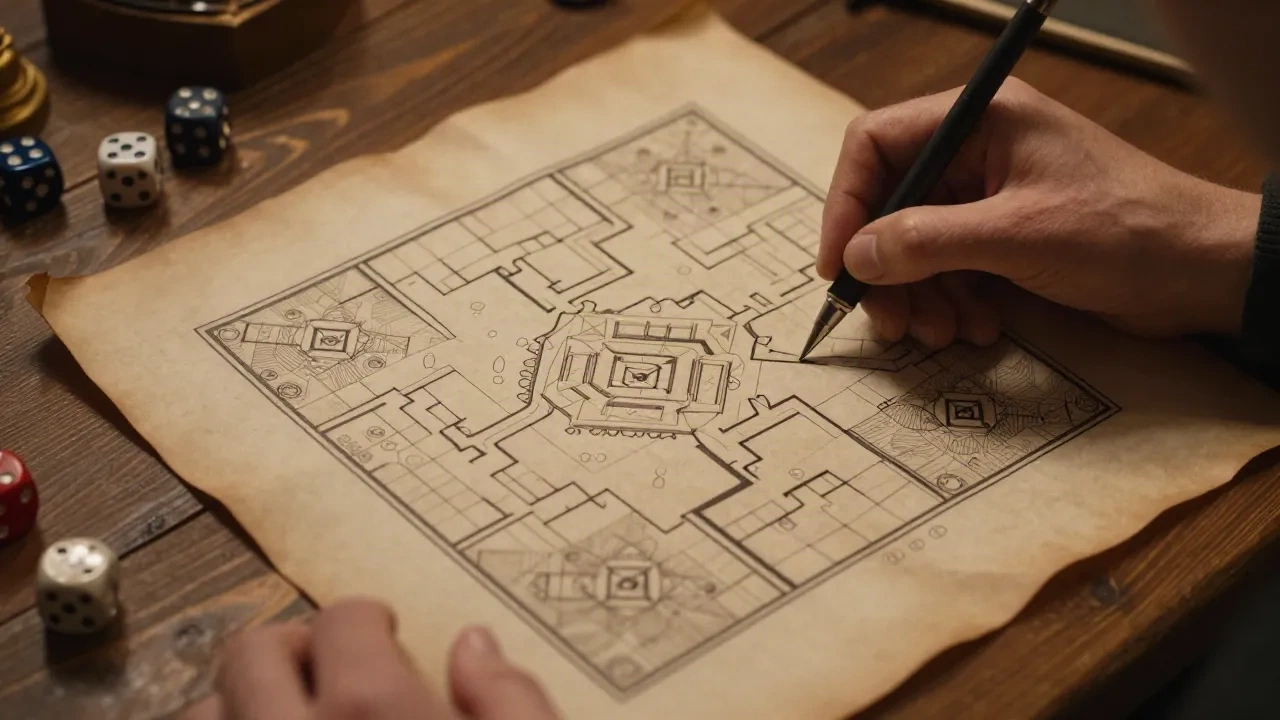
What is procedural generation? It is the algorithmic method of building content -- dungeons, terrain, faction name lists, weather sequences -- from rule sets and randomness rather than hand-placement. The designer or GM defines the rules; the algorithm applies them. Not pure chaos, not handcraft: it sits between the two, which is exactly what makes it useful for worldbuilders who need volume without losing coherence. After session 63 of my Pathfinder 2e campaign, I stopped drawing every dungeon level by hand -- not out of laziness, but out of necessity. Six connected mine shafts by Thursday, four hours to prep them. That is when I understood procedural generation as a grammar, not a magic box.
What Procedural Generation Actually Does -- and Does Not Do
The common pitch is "infinite worlds." The reality is more specific and more useful. Procedural generation takes a set of parameters -- room count, corridor density, enemy type ratios, biome distribution thresholds -- and applies algorithms to produce an output that satisfies those parameters. The result can feel infinite because the parameter space is large, not because the algorithm invents freely. Every output is bounded by the rules the designer encoded.
No Man's Sky is the extreme example: 18 quintillion planets generated from a single seed architecture. Each planet is procedurally distinct in name, atmosphere composition, and terrain shape. The underlying generation rules are fixed and finite. The variety comes from the parameter space, not from the algorithm escaping its constraints.
For GMs, the practical implication is direct: a dungeon generator does not know about the faction controlling that mine, the promise you made your players in session 7, or the artifact they are looking for. It produces geometrically plausible space. Canon coherence is still your job. The lore either earns belief or it does not -- and no algorithm reads your campaign notes.
The Seed: How One Number Anchors an Entire World
Every procedurally generated output traces back to a seed -- an integer that initializes the random number generator. Feed the same seed to the same algorithm and you get the same output every time. That determinism is the feature most tutorials skip over, and it is arguably more useful than the generation itself.
For TTRPG prep, seed determinism matters in three distinct ways. First, you can reproduce a generated dungeon exactly after a session runs it -- the seed is your save state, not the map image. Second, you can share a seed with other GMs running the same tool and let them work with identical geometry, keyed differently for their own campaigns. Third, when a generation comes out badly -- rooms too cramped, exits misaligned, a dead-end that makes no spatial sense -- you can iterate seeds in seconds until you find geometry that fits your session, then lock it.
Minecraft has made this mechanic culturally familiar. Players exchange seed values to share starting terrain. The same pattern appears in tabletop tools: Donjon generates dungeons with shareable seeds, and Watabou's Procgen Arcana exposes the seed as a copyable value at the top of every generation. Your seed is your session bookmark.
Four Algorithms That Shape Most of What You Play
Most procedural generation in games and TTRPG tools runs on a small set of underlying approaches. You do not need to write code to work with these, but knowing their character changes how you evaluate any generator you consider using for session prep.
Perlin and Simplex Noise produce smooth, organic variation. The undulating terrain in Minecraft, elevation maps, fog-of-war density fields -- all Perlin noise. The key technique is layering: running multiple octaves of noise at different scales simultaneously, so large-scale terrain shape gets fine-grained surface detail added on top. Output reads as natural rather than chaotic because the variation is continuous, not random-per-cell.
Wave Function Collapse works by example. You provide a tile set with adjacency rules -- this wall type can border this floor type, not that corridor -- and the algorithm solves a grid to produce output that respects every rule. Used heavily in tile-based dungeon generators. Output feels handcrafted because the rules encode design taste; you are essentially teaching the algorithm what your aesthetic accepts.
Cellular Automata applies neighbor-counting rules iteratively across a grid. A typical cave-generation rule: any cell with five or more wall neighbors becomes a wall; otherwise it becomes floor. Run this for four to six iterations on a randomly seeded grid and you get organic cave formations. Fast, requires no tile library, produces terrain that reads as geological rather than architectural.
Binary Space Partitioning (BSP) recursively divides a rectangular space into smaller rectangles, converts them into rooms, then connects them with corridors. BSP guarantees every room is reachable -- a critical constraint for roguelikes where an unreachable room is a broken run. Most dungeon generators that feel clean and navigationally coherent use BSP underneath. The geometry is regular, which is why GM-facing tools often layer Perlin noise on top to soften the grid feel.
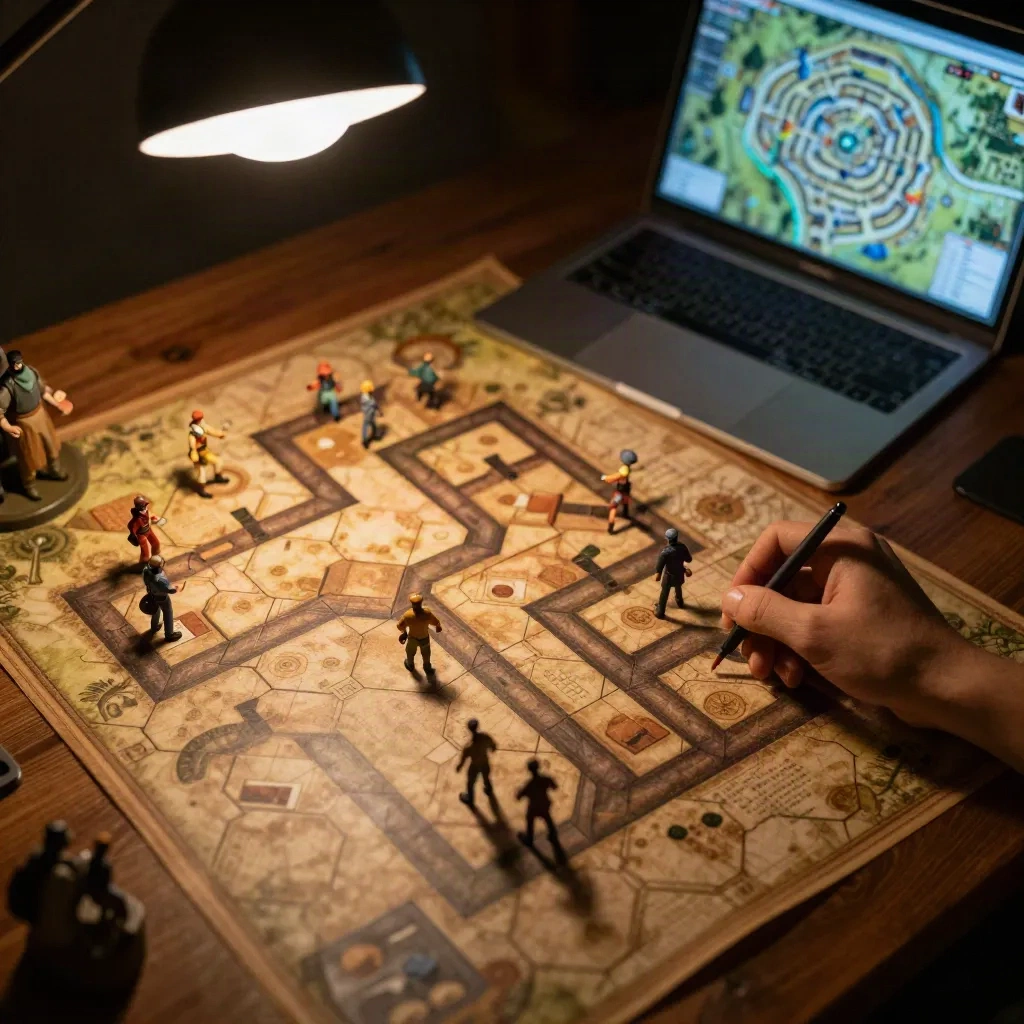
Why Pure Procedural Generation Always Falls Apart -- and Why Hybrid Wins
Ask any GM who has attempted a fully procedurally generated campaign: the problem is never the geometry. It is the meaning. Algorithms produce structures; they do not produce stakes.
Hades, Spelunky, and The Binding of Isaac are the case studies. None of them are purely procedural. Each layers handcrafted components -- enemy types, boss encounters, room templates, dialogue, narrative beats -- on top of procedural assembly. The procedural system shuffles and recombines; the hand-designed elements carry the weight. The algorithm provides variety; the design provides craft.
The ratio matters more than people acknowledge. Spelunky 2 keeps each area's room template set small enough that veteran players read a level's rhythm after two rooms. Hades scripts its narrative beats on top of procedural runs -- the randomness affects difficulty curve, not story. The Binding of Isaac's item pool is enormous precisely because the handcrafted items are what players remember, not the room layout that contained them.
At the table, the same principle holds. Procedural structure plus your narrative layer is stronger than either alone. The algorithm saves you the geometry work. You spend that time on what matters: the three rooms in this dungeon that connect to your campaign arc, the faction motivation that explains why the mine is occupied, the detail that makes your players feel the world was here before they arrived.
At the Table: What the Tools Actually Generate vs. What You Still Write
Six weeks of campaign prep across three different systems -- Pathfinder 2e, Ironsworn, and a homebrew hexcrawl -- taught me exactly where the line sits.
Tools generate reliably: room geometry and connectivity, corridor density and branching patterns, encounter type tags (not specific statblocks), treasure category assignments (not specific items), NPC name lists, weather sequences for hexcrawl weeks, terrain type distributions across regional maps.
Tools generate unreliably: faction motivations, narrative hooks that connect to an existing story arc, dialogue and NPC personality, cultural details consistent with a specific realm's established lore, anything requiring knowledge of what happened in previous sessions.
The workflow that holds up: use the generator for the skeleton, spend 20 minutes keying it yourself. A Donjon dungeon gives you 14 rooms with rough encounter tags and random treasure rolls. You decide which three rooms matter to this session's arc, what the faction occupying this space actually wants, and what the players discover that changes their understanding of the world. The other eleven rooms hold up under casual exploration without additional work. That is the value proposition -- not "the AI builds your world" but "the algorithm handles the geometry so you can write what earns belief."
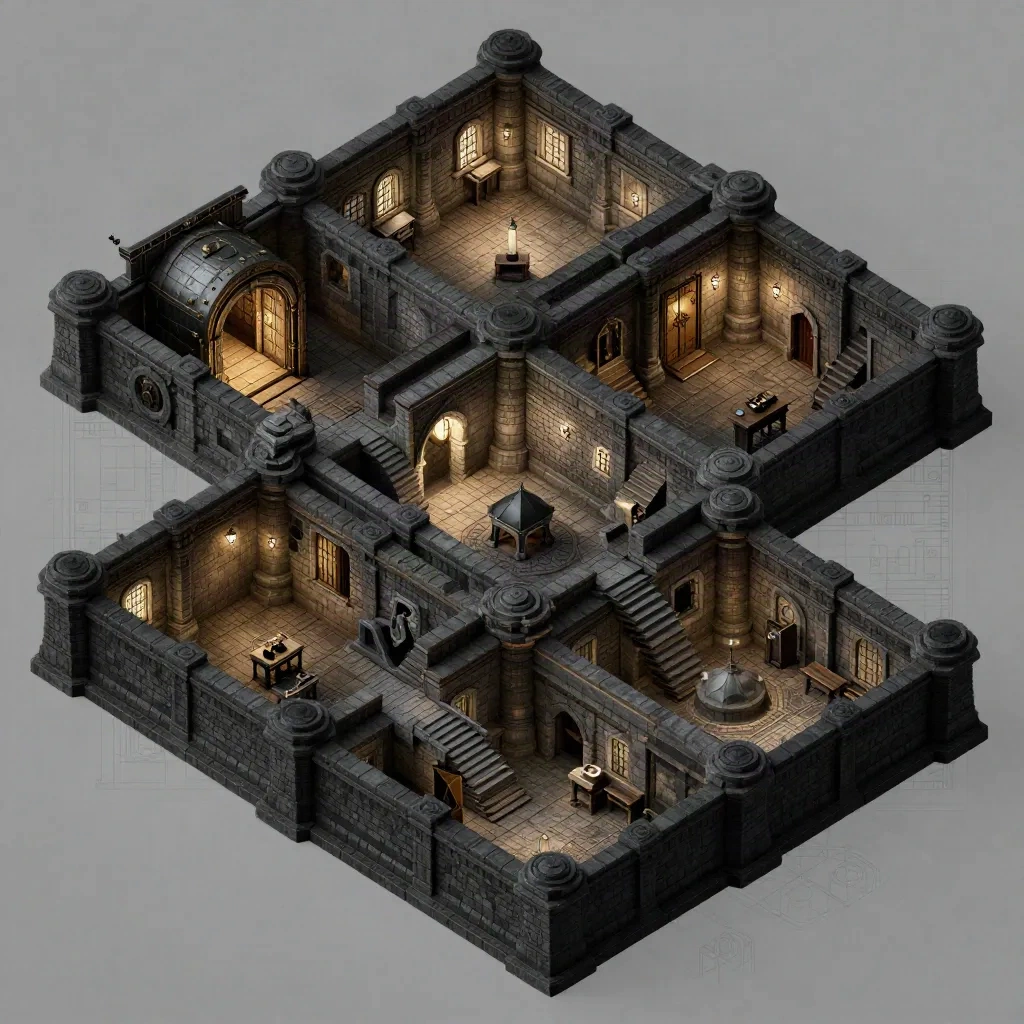
Three Examples Worth Studying Before Your Next Session
No Man's Sky makes seed determinism visible and social. Every planet has a coordinate system encoding its seed; players share coordinates so others can visit discoveries. For worldbuilders, the lesson is about shared reference: a seed creates a canonical location that multiple people can verify. Your players can explore the same procedurally generated ruin and walk away with identical spatial memory of it.
Spelunky 2 demonstrates well-constrained procgen. Each area uses a fixed template set; the generator assembles them in varying order. Variety is real but bounded -- veteran players read the level rhythm quickly. The craft is entirely in the template design, not the assembly algorithm. This is the TTRPG lesson: the quality of your generated content is limited by the quality of the rules you gave the generator.
Watabou's Procgen Arcana (browser-based, free) is the clearest working demonstration for tabletop purposes. It generates city maps, dungeon layouts, and regional maps with exposed seed control and adjustable parameters. Every configuration choice is a toggleable option, which makes it a readable tutorial in how procgen constraints shape output. Use it for three sessions and you will understand cellular automata, BSP, and seed determinism by feel rather than definition.
When Should You Let the Algorithm Roll First?
Skip procgen when the location carries narrative weight you have already established. If the players are finally entering the capital city they have heard referenced for 18 sessions, that city should be hand-built, every district placed to serve the story you have been running. An algorithm cannot know what you promised. The Forge produces raw material; it does not know your campaign's commitments.
Use procgen when you need plausible structure fast and the location is genuinely new -- to you and to the players. Side dungeons, incidental wilderness, the unexpected city your party decided to visit between planned sessions: these are exactly where a competent generator saves three hours without costing canon coherence. No one is emotionally invested in the geometry of a mine you rolled at midnight.
The practical rule: let the algorithm roll first when plausible structure is more valuable than perfect structure. Then key the three rooms that matter. Leave the rest as generated. Here's how it holds up at the table -- every session, reliably, since I stopped treating procgen as a crutch and started treating it as a first pass.